Sabtu, 31 Oktober 2009

Ancient Bicycle

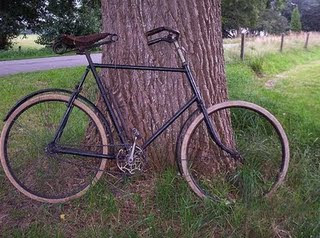
ancient bicycle transportation simple to use human power to drive the motion of the coiled chains in one of the driving wheel by using the human foot.

Its serial number 58,334, frame size 660mm, Gazelle rear tires from Vredestein made before the war (1937) and still be able to climb despite being glued to the pelk.

Bicycle model earlier times, a very antique Simplex branded Seri8, Lights: BOSCH GERMANY Dinamo: BOSCH GERMANY, Standard: KOBA JAPAN, Stang / Stir: CHINA.

READ MORE - Ancient Bicycle

Jumat, 30 Oktober 2009

Old car


DATSUN

Old car is a vehicle that has a total of four wheels or more with the engine and body are very old and no longer produced by the factory but now many people who seek it as a collection of vintage cars. This phenomenal car, according to his fans is a "Kejaiban" technology, not from the model, but the engine performance and "handling" it. In addition to the standard machine with high capacity, which makes the Datsun 510 remains popular to this day is the ease for the "upgrade" to the Datsun parts other versions. Backed by a strong framework, as well as a flexible engine room, various types of machines with high capacity from next-generation Datsun, Datsun engine 510 1600 box installed with little modification. For example :

  1. Machine, can the upgrade of the type: 1.6l - 1.8l to L1.6 - L1.8, even using the type 2.0l - L20B a much greater capacity or a turbo version with a maximum capacity.
  2. Transmission of the 4-speed manual can be upgraded to:
  • 63mm (shaft-center distance) 5-speed transmissions" made for 200sx (S10) and HL510 (A10).
  • 71mm 5-speed transmissions", which is used in the 280-Z series (s30 & S130), 200sx '80-'83 (S110) in production from 1980 to 1983, 810 production 1977-1980, 810/Maxima/Bluebird (910) production years 1981-1984, C210/R30 Skyline series. This transmission is used in the series pick-up/truck type 620/720/D21

From the management side, Datsun 510 early version has been equipped with various equipment and accessories that support the ability of the engine and the toughness as : Brake discs at the front wheels. Independent suspension on the 4 wheels (MacPherson strut front and semi-trailing arm at the back. For the station wagon with "solid rear live axle and leaf springs at the rear. Using the rear-wheel drive system. Transmission of two kinds, namely: 4-speed manual or 3-speed automatic. Available in versions: 2-door sedan, 4-door sedan, and station-door wagon 4. Fuel consumption: 20-30 mpg (test plant in the United States). Any type specification Datsun 510 with the United States, since 1970 has been equipped with "anti-sun glass.


READ MORE - Old car
READ MORE - Old car

Old House Castle Museum, Yogyakarta


Fort Vredeburg

News August 17, 1945 Proclamation received by the Office of the Yogyakarta branch Domei news gave rise to various actions, including: red and white flag raising, seizure of the building and disarmament of the Japanese. After the fort Vredeburg controlled by the RI, then handed over to the military agencies' n used as a dormitory and headquarters staff of the army with the code 'Q', under the command of Lieutenant Junior I Radio. The task force's taking care of military supplies.

At the time of the Military Aggression II, December 19, 1948, the fort Vredeburg Dutch bomb targets so that the office is therein TKR destroyed. Dutch troops under the command of Colonel Van Langen successfully mastered Yogyakarta including Vredeburg fort, later used as a headquarters fort IVG (Informatie Voor Geheimen or Dutch secret service). Besides Vredeburg fort also served as a dormitory soldier 'n western weapons storage (tanks, armored' n other military vehicles).

After the Dutch left Yogyakarta (Yogya event Back, June 29, 1949) Vredeburg fortress controlled by APRI (Armed Forces) that the management handed over to the Military School Academy. After the G 30 S / PKI (year 1965) for a while fort Vredeburg used as a political prisoner (political prisoners) under the supervision Dephankam.

In 1976 held the fort building feasibility study, then the process of building towards the preservation of the fort continued to run. Dated August 9, 1980 signing of an agreement made between the Sri Sultan Hamengkubuwono IX, as the party I 'n Dr. David Joseph (Education Minister at the time) as the II on 'Utilization of the former fort Vredeburg building as a center of information and cultural development of the archipelago'. 1981 year old castle Vredeburg buildings designated as Heritage Objects (BCB) based on the Decree of the Minister of Education and Culture No. RI. 0224/U/1981, dated July 15, 1981. November 5, 1984, Prof.. Dr. Nugroho Notosusanto (Education Minister at the time) said that the former castle building Vredeburg will function as the National Struggle Museum. In the agreement and letter of Sri Sultan HB IX No. 359/HB/85, April 16, 1985, stated that the changes in spatial structure of buildings in the fort complex is permitted in accordance with needs. To further restoration work done to improve building functions as a museum. The museum opened in 1987 'n can be visited by the public. 23 November 1992 the former building official Vredeburg fort became the Museum of National Struggle under the Special Education Minister Decree RI (then chaired by Prof.. Dr. Fuad Hasan) No. 0475/O/1992, with the name 'Castle Museum, Yogyakarta'.

READ MORE - Old House Castle Museum, Yogyakarta

Prehistoric


Prehistoric life style INDONESIA AND RESULTS culture.

Results of prehistoric human culture to maintain and improve the pattern of his life to produce two forms of culture are: Cultural form that is Spiritual, Cultural form that is Spiritual, Prehistoric societies have belief in supernatural powers, namely:

  1. Dynamism, which is belief in things that are considered to have supernatural powers. For example: rock, kris.
  2. Animism, the belief in spirits of their ancestors who dwell in boulders, mountains, big trees. The Spirit is called Hyang.

Patterns of prehistoric human life are :

  1. Is Nomad (sedentary living), which is not yet settled life patterns and clustered in one place as well, their livelihood is hunting and gathering food.
  2. Is Sedenter (settled), the pattern of life was organized and grouped, and settled in one place, farming livelihoods. Begun to know the customary norm, which is based on habits.

Farming systems / agriculture :

  1. They began using the hoe and plow as a farming tool.
  2. Using animals to cows and buffaloes plowing.
  3. Human system to grow rice.
  4. Unknown fertilization system.


Sailing
In prehistoric human voyage already know the direction of the wind and know the position of the star as a determinant of the direction (compass)
Language
According to Prof. results. Dr. H. Kern, the language used, including the Austronesian language family: Indonesian, Polynesia, Melanesia, and Micronesia.
Occurrence of language differences between regions due to the influence of geographical factors and the development of language.

Type of early human fossils Indonesia :
01. Meganthropus Paleojavanicus (Sangiran).
02. Pithecanthropus Robustus (Trinil).manusia-purba
03. Pithecanthropus Erectus (Homo Erectus) (Trinil).
04. Pithecanthropus Dubius (Jetis).
05. Pithecanthropus Mojokertensis (Perning).
06. Homo Javanensis (Sambung Macan).
07. Homo Soloensis (Ngandong).
08. Homo Sapiens Archaic.
09. Homo Sapiens Neandertahlman Asia.
10. Homo Sapiens Wajakensis (Tulungagung)
11. Homo Modernman.


Stone Age is the period of extensive prehistoric times, when humans created tools from stone (for not having better technology). Wood, bone, and other materials are also used, but the rock (mainly flint) was formed to be used as cutting tools and weapons. The term is derived system of three ages. Stone Age is now divided again into the Paleolitikum, Mesolitikum, and Neolithic, each of which again sorted further.

Palaeolitikum = The old stone age (palaeolitikum), so called because the stone tools made by humans is still done in rough, not rough or dipolis. When viewed from the corner of his living this period is called the hunting and gathering food simple level. Supporting this culture is composed of Homo Erectus. Earliest period of human civilization is marked by the discovery of fossils of early humans in scientific computation was about 1 million years ago as Phitecantropus Erectus, the size of his thigh bone (femur) can be categorized as homo erectus or upright man. And hunting equipment such as handheld axes, showing patterns of human production of that period are still in the hunt. In this period people are still moving from place to place one another in an attempt to get the game.

Neolithic, also called the Neolithic, the phase or the level of culture in prehistoric times that has the characteristics of cultural elements, such as equipment from a sharpened stone, permanent agriculture, livestock, and making pottery.
Early young rock is also referred to as the initial planting in 1500 ranged years ago in Indonesia. Most people in the era of the Paleo-Mongoloid rice. They began to settle and build a farm to live with using simple tools like the pickaxe found scattered in the western archipelago. This tool is also found in Yunnan, South China, Laos shows the human migration from the north through the Mekong river. In the eastern archipelago in many elongated axes are also found in Japan, Taiwan, Philippines, North Sulawesi, Maluku, Papua and other islands of Melanesia. Advanced biological studies showed that the similarity structure of DNA in the blood of humans in this region have similarities, this shows the ancestors came from Indonesia some of the Asian mainland and partly a mixture of Negroid and Mongoloid and Negroid mainly located in the eastern islands . In his spare time waiting for the harvest, they began to have the time to understand the universe and the forces of the Great to simplify their lives. So they started to build places of worship in the form of large stones like Menhir, stone-story building, dolmen and statues of their ancestors, then the end of this time period also known as megaliths.

Megalithikum is a large stone cultural terms (Mega = large; Lithos = stone).
Megalithikum culture is not an age of growing its own, but rather a result of the culture that arose in the time Neolithikum and thrive in the days of metal. Every building that was created by the community would have a function.
(Batu Muda / Neolithikum It is an era in which the tools of human life is made of stone that have been mashed, and form more perfect than the previous period. For example: ax square and oval axes.)

Contained in the Prehistoric Room is a collection of objects of prehistoric relics, among others:

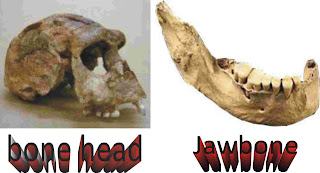
  1. Replicas of human skulls and bones of ancient.
  2. Megalithic statues (human or animal form).

  3. Replica of a stone coffin tomb, the tomb stones in the box was also found in the beads, pottery, and items that come included with the dead were buried.

  4. The tools of metal, such as: ax funnel, arrowheads, spear eyes.
  5. Pottery.
  6. Stone tools of Paleolithic sites Kali Oyo, Hamlet Randusari, Watusigar Village, Sub Ngawen, Gunung Kidul Regency, Yogyakarta Special Region. Stone tools they will be penetak ax, ax perimbas, tool flakes, elongated axes, pickaxe.


A Oopart (Out Of Place artifacts / artifact that is not in place) is a term given to dozens of prehistoric objects found in various places around the world with the level of a completely different technology to determine the age when based physical, chemical and / or with instructions geologic.

Prehistoric trail

At times paleolithikum, used stone tools are still very rough. Over time, the equipment was developed with the physical forms are more subtle, especially in the era neolithikum.

Given the lack of metal tools, you can bet that is made by cutting or in friction with the other rocks. Thus, making sure that does not take a minute. For ease of use, this type of axes may be given a wooden handle of a clipped, and tied with rattan ropes. Prehistoric ax I get from the South Sukabumi, has a different physical form of stone axes from Pawon Sand Peak. At that time, in the middle of the fun enjoying the panoramic view of limestone hills nearly destroyed, I accidentally found it in a tucked position between the holes of limestone. The ax has a 8.5 cm long, 2.5 wide base and the eyes are toothless measuring 3.5 cm. Huntu than dark, much more rough surface. He was also of course much older. Characteristics, indicates that prehistoric humans had known Pawon Cave rock culture center (mesolithikum). 

READ MORE - Prehistoric

Chairs and Table Clasic


Table is a place for learning or doing any activities with a stationery such as pencils, use the table of an object that has flat feet that more than two, there are signs on it that serves to prop or pads when he wrote in a notebook. today many collectors are looking for unique furniture or unique objects such as tables and chairs in earlier times.


Chairs are objects that have a physical form consists of four legs, back to back back and body (board) to sit down. Stout chair model in search of today is the ancient seat models available in the past with a different form from now. with the model rather strange and unique collectors were more old chairs, old chairs placed anywhere matches. in the form of fission is very unique ancient seats, and has a different artistic form of the chair now.

READ MORE - Chairs and Table Clasic

Keris (kris) in JAVA


warangka yogyakarta

Sheath in the form similar to Yogyakarta, Surakarta, only slightly smaller in size, its style is more singset. That looks similar to the sheath Ladrang, in Yogyakarta called branggah. Wood branggah sheath makers in Yogyakarta is wood trembalo and timaha. Actually the use of sheaths in Yogyakarta branggah with Ladrang sheaths in Surakarta, but several decades of this standard is not too tight in the community.


Warangka Surakarta

Usually made of fragrant sandalwood or sandalwood Sumbawa (sandalwood - Santalum album L.) The second option is trembalo wood, then wood pellets timaha. Warangka Ladrang syllables divided into four main Kasatriyan Ladrang, Ladrang Duchy, Ladrang Capu, and Ladrang disorder. The two last shapes are now rarely made, thus have become rare. Warangka Ladrang is kind of worn sheaths to attend a ceremony, party, and the user is not on duty. When compared to the military clothing, clothing belonging to the sheath Ladrang Office Ceremony (PDU).


Pendok

serves as a protective or coating axle, which is part of the sheath of the kris soft wood. However, the protective function is then turned into a means to display luxury. Simple Pendok usually made of brass or copper, but that luxury is made of silver or gold set with jewels. Pendok form some kind, ie pendok bunton, blewehan, slorok and topengan.


Luk

This term is used for a keris is not straight, but curved or grooved. Luk at kris always uneven, is never even. The count starts from the bay three to luk thirteen. That is a normal keris. If more than 13 luk, regarded as abnormal kris, and called the keris kalawijan or palawijan.

The number of keris luk always uneven, is never even. In addition, the rhythm of the keris luk divided into three groups. First, luk a shallow or vague. Second, the sedeng luk or medium. And third, who luk rengkol - of which the rhythms around her stern.


keris bugis

In the keris culture there are a number of foreign-sounding terms for the layman. Understanding of these terms will be very useful in the process of understanding of the keris. The term in the world of the keris, especially in Java, which is often used: angsar, kitchen, prestige, furniture, tough, tanjeg, and so forth.

Below is a brief description alphabetically arranged about the keris. The term is commonly used in Java and Madura, but understandable and sometimes also used in other areas, such as Sulawesi, Sumatra, and even in Malaysia, Singapore, and Brunei Darussalam.

Angsar

is a supernatural power that is believed by some to be found in a keris. Power supernatural or occult power is not visible, but can be felt by those who believe. Angsar can have a good or positive, may also reverse.

Basically, all the keris was angsar good. But sometimes, good angsar was not necessarily suitable for everyone. For example, the keris has a good angsar for a soldier, almost certainly not suitable if it is owned by a trader. Keris who has a good angsar for a leader who had many men, not suitable for low-ranking employees.

To get to know angsar kris, requires knowledge of tanjeg. While fit and to determine whether or not someone with angsar a keris, requires knowledge of tayuh.

Dapur

Is a term used to describe the shape or type of a keris. In the name of the kris kitchen, people who had understood immediately known, such as the keris form what is meant. For example, someone says: "Kris has a form of bedding dapur Upih", the listener will immediately know that the keris is a straight keris, not the keris luk. Another if it is called the kitchen Inten belt, then it must keris luk to eleven.

keris in ethnic communities know Java more than 145 kinds of kitchen keris. But of that number, which is considered as a standard kitchen keris or follow standard are only about 120 of course. Centini, one written source, which can be regarded as guidelines for the standard kris kitchen includes details of the kitchen keris follows:

There are 40 straight keris of the kitchen. Keris three luk 11 kinds. Keris luk five have 12 kinds. Keris luk seven have 8 kinds. Keris luk nine have 13 kinds. Keris luk there are 10 kinds of eleven. Keris luk thirteen has 11 kinds. Keris fifteen luk 3 kinds. Keris luk there are 2 kinds of seventeen. Keris luk nineteen, twenty-nine to luk each some kind.


READ MORE - Keris (kris) in JAVA

buggy


buggy

buggy or a buggy is a means of transportation without the engine, driving a horse or a buffalo / cow. transportation is very simple but comfortable and can enjoy the antique atmosphere with up buggy / buggy.

READ MORE - buggy
READ MORE - buggy
.::BY JUMBHO-MY AT HOME IN THE JEPARA CITY OF BEAUTIFUL::.